

After centuries of international isolation, Japan was opened to Western trade and cultural influence in the 1850s. The years that followed saw a wave of ‘Japonisme’, and the first generation of Western Japanophiles made their way to Japan, often adopting Japanese names and writing books about the country. Most, like Ernest Fenellosa and Basil Chamberlain, have been almost entirely forgotten today except. But the most influential of all of them is also the only one who is still remembered at all – not in the West, but in Japan itself.
Lafcadio Hearn (1850–1904) was a half-Greek, half-Irish writer who grew up in Dublin, then learned his trade in the US before moving to Japan in 1890. He was extremely popular in his day – in the words of one commentator:
Hearn’s writing from Japan more than any other to this day has shaped Western perception of the country, taking on such a life in the early years of the [twentieth] century that it returned to Japan by way of the looking glass of the West and became determinative in shaping even Japanese perceptions of Japan.1
In the West, Lafcadio Hearn has been largely forgotten. If a non-Japanese has heard of him at all, it is likely as a meme historical figure that prefigured the reputation of white boys for having inordinate fondness for East Asia. Hearn was recently catalogued as ‘the first weeb’ on Noah Smith’s Substack. But in Japan – where he is known under his adopted name of Koizumi Yakumo – Hearn remains a standard part of the Japanese school curriculum as an important cultural figure in Meiji history.2
The marriage between Lafcadio Hearn’s Irish Protestant father and his Greek mother collapsed before he was seven. Young Lafcadio was shuttled between distant relatives and eventually crossed the Atlantic alone as a young adult, ending up homeless in Cincinnati before being taken in by a patron who encouraged his literary ambitions and helped him become a journalist – first in Cincinnati, and then New Orleans.
His early journalism was florid ‘true crime’,3 but in New Orleans his attention shifted to culture. Deeply interested in creole culture, language, and voodoo, he even published a collection of Creole proverbs and the first-ever published Creole cookbook. He embraced the Romantic belief in the wisdom and value embedded in folk culture, which at the same time was giving rise to the Gaelic Revival in Hearn’s native Ireland. He robustly defended policies that would help preserve ‘old-fashioned manners and customs’, such as pro–French language policies in Louisiana (a few years before the Gaelic League was founded to promote similar approaches).4 He brought the same attitude to Martinique and then Japan, where his prose tightened and his ‘sketches’ of the country became Westerners’ favourite source for understanding Japanese society.
Hearn first travelled to Japan in 1890, on assignment for Harper’s Magazine. He soon broke with them, and his Japanologist mentor Basil Chamberlain arranged for him to get a job as an English teacher in Izumo in Shimane Prefecture. The Japan he arrived in was in the middle of perhaps the most rapid transformation of any in history – from isolated agricultural society to industrialised great power in barely a generation. Unlike Creole society in New Orleans, Japanese society was newly emboldened, confident, and powerful.
But Hearn approached this very different society with the same lens he had developed in New Orleans. He would later recall that on arriving in the country and first taking in his new home, his impressions were not of social change or industrialisation, but rather of Romantic ‘wonder’ and ‘delight’ at the natural beauty of ‘Japan as seen in the white sunshine of a perfect spring day’. Of course, it was inevitable that he would notice the rapid changes happening around him. But he continued to focus on the beauty and simplicity of what he called ‘Old Japan’, a culture that he idealised and that he worried was, like Creole culture in New Orleans, disappearing even before his very eyes. ‘What is there, after all, to love in Japan,’ he once wrote to a fellow Japoniste, ‘except what is passing away?’5
Among the exotic aspects of Old Japanese culture that Hearn ‘sketched’ for Western audiences were its traditional dress (which he himself adopted, along with a Japanese name); its class system with samurai and daimyo; its customs and sense of honour and morality; and its martial arts. One particular essay on this last topic used ‘jiujutsu’ as a metaphor for the way Japan had begun to compete against Western powers using Western knowledge and industrial techniques:
What Western brain could have elaborated this strange teaching, never to oppose force by force, but only direct and utilize the power of attack; to overthrow the enemy solely through his own strength, to vanquish him solely by his own efforts? Surely none! The Western mind appears to work in straight lines; the Oriental, in wonderful curves and circles.
The idea that there was an essence of eastern culture, standing in opposition to uniform western culture, could reasonably be called orientalist. But it wasn’t much different from the essentialised distinction between Anglophone and French culture that Hearn had used in his journalism in Louisiana,6 or the essentialised distinction between Saxon and Celtic culture that was developing in Ireland at the same time. It was all part of a broad Romantic approach to culture that was widespread throughout nineteenth-century Europe and America.
Although Hearn praised the Japanese for their ability to compete against the West using the West’s own tools, he was apprehensive that a focus on competition might lead the Japanese people to conclude that ‘there can be no development if we continue to follow our ancient morals and manners’. So, like collectors of fairy-folklore in Ireland, part of his mission was finding ‘survivals’ from the old culture: as Naoya Shiga put it, ‘Hearn interpreted Japanese things which have been forgotten by Japanese themselves…’7
It should be obvious that Japanese culture is more complicated than the Romantic cliché; and, when he was at his best, Hearn appreciated some of that complexity.
One of Hearn’s best essays, ‘A Conservative’, is a portrait of a member of the samurai class living through the arrival of Western trade, the opening of the country, and the Meiji Restoration. Faced with a whirlwind of cultural change, he begins to learn more about Western culture and becomes deeply impressed with what he sees as its scientific and commercial superiority. He begins to abandon his Old Japanese habits and customs, and even briefly converts to Christianity. But as he spends more time in the West and comes face-to-face with the squalor and poverty of industrial cities, he comes to believe that Western scientific and industrial might could not compensate for the moral emptiness of Western society.8
Hearn’s protagonist then formulates a new synthesis. Given the competition it faced from expansionist Western empires, ‘Japan would have to learn the new forms of action, to master the new forms of thought, or to perish utterly. There was no other alternative’: certainly not a return to isolationism. But Japan could try to compete in a way that maintained or even strengthened Old Japanese ‘ideas of right and wrong, of duty and of honour’. Japanese culture would have to change, but that change did not necessarily have to involve a repudiation of the deepest moral values embedded in that culture.
Having formulated this new creed, Hearn’s conservative returns to Japan again for the first time in many years; and upon seeing his homeland from the ship, ‘the lips of the man murmured again, with sudden new-found meaning, the simple prayer of the child.’
In ‘A Conservative’, Hearn clearly described a phenomenon that some of his other writings oversimplify. In late Meiji Japan, an emerging conservative nationalism sought to synthesise modernisation and tradition – to guide Japan’s rapid development in (what they thought of as) a distinctive Japanese way. Hearn grasped that the conservatives could simply preserve the old culture; what they were aiming to preserve was the old culture’s core values.
This distinction, between culture itself and the deepest moral values embedded into it, is helpful for understanding conservative nationalism anywhere. But Hearn all-too-often lost his grip on it, which hurt his understanding of Japanese culture. When Hearn wrote about watching ‘jiujutsu’, for example, what he was actually witnessing was judo – a martial art so recently-developed that it had not yet been widely accepted as distinct (hence the naming confusion), and which Hearn was learning about from the man who had invented it. To be sure, judo drew from traditional and ancient martial arts, but it was also something genuinely original; Hearn had the intellectual resources to understand this combination of old and new, but he found it too easy to fall back on Romantic clichés.
A more politically serious example is the ‘Emperor System’ that developed during the Meiji Restoration, when power was transferred to the previously-enfeebled emperor, and absolute loyalty to his sovereignty was stressed throughout Japanese life. Hearn missed its novelty entirely, writing about it as ancient – a logical outgrowth of Shinto ancestor-worship, whereby ‘[t]he power of the ruler was unlimited because the power of all the dead supported him.’
Losing track of these subtleties led Hearn into a few genuinely embarrassing blunders. Believing love of the Emperor was ancient and that modernisation was eroding it, he claimed that ‘the ignorant, blind indifference’ of the educational system was failing to ‘nourish the old love of country and love of the Emperor’ – in the face of all the evidence of Meiji Japan. Basil Chamberlain had to politely correct him with examples of newly-developed practices: ‘What of the prostration at New Year before the Emperor’s picture? What of the students’ military drill? What of the creation of such festivals as the Emperor’s birthday, the late Emperor’s anniversary, the 11th February?’9
How could Hearn have blundered like this? Part of it is that he just never became fluent in Japanese. This severely limited his research abilities, and meant that he largely relied on educated English-speakers for his information: as part of the conservative nationalism of the period, these Japanese elites generally stressed the ancient roots of modern Japanese institutions. But ‘A Conservative’ shows he could think more subtly; he was smart enough to have been more sceptical, had he felt the need.
But too often Hearn didn’t feel the need, because doing so would have meant questioning his foundational theoretical framework. If Hearn had one big idea, it was his belief that all social norms and ethics emerged out of a kind of ancestor-worship.
It would be easy to psychoanalyse Hearn’s obsession with the idea of ancestor-worship as a kind of overcompensation for the fact that, having been abandoned by his parents, he had little connection with either of his own sets of ancestors. You could also see an indirect influence from the great Irish political theorist Edmund Burke, whose defence of tradition in Reflections on the Revolution in France was rooted in the idea that society was a contract ‘between those who are living, those who are dead, and those who are yet to be born’.
But the more direct influence came from the English thinker Herbert Spencer. To modern readers who go back to his works, Spencer seems quite weird: his ‘evolutionist’ theory united biological and cultural evolution, but it gives the strong impression of being the brainchild of someone who had only heard the vaguest outline of what Darwin argued.10 But in his day, Spencer’s attempt to unite all the human sciences (history, philosophy, sociology, economics) in a grand synthesis was extremely influential, and Hearn was not alone in believing him to be the world’s greatest thinker.
Hearn was so in awe of Spencer that, when Spencer recommended that Japan should limit interracial marriage and bar the children of foreigners from citizenship, Hearn repeated these recommendations – despite having a Japanese wife.11
When Herbert Spencer speculated about the earliest, ‘savage’ state in human evolution, one thing he emphasised was the relationship between the living and the dead:
the savage, conceiving a corpse to be deserted by the active personality who dwelt in it, conceives this active personality to be still existing, and that his feelings and ideas concerning it form the basis of his superstitions.12
Spencer argued that savages feel an ‘unqualified’, religious deference to the ghosts they superstitiously believe in. As such, ancestor-worship forms the basis of savage law, morality, culture, and religion: ‘law, whether written or unwritten, formulates the rule of the dead over the living’. Spencer thought that this ‘tacit ancestor-worship’ persisted in some form in more ‘advanced stages of civilisation’, but that in higher and higher civilisations it gradually weakened through the ‘modifying of old laws and making of new ones’; the ‘highest’ civilisations inevitably tended away from ancestor-worship and towards a philosophical worship of ‘the Unknowable’.13
Lafcadio Hearn’s understanding of culture, religion, and morality was all rooted in this Spencerian theory. But Spencer’s ‘evolutionism’, which suggested that survivals from minority cultures were all so much cultural detritus to be cast away by progress, was in serious tension with the Romantic beliefs he had advanced in New Orleans. The tension came to a head in Japan, where he encountered a society that practised a form of literal ancestor-worship, which the Romantic in him implicitly wanted to protect but which Spencer seemed to predict would inevitably be cast aside by progress.
Hearn tried to resolve this tension by drawing on another of Spencer’s ideas, ‘organic memory’ or (as Hearn and others often called it) ‘race memory’. The idea is that each person, in a Lamarckian fashion, inherits unconscious ideas and knowledge from the experience of their ancestors. Hearn strongly emphasised the importance of this kind of unconscious interpersonal memory, and used it to justify ancestor-worship:
When we become conscious that we owe whatever is wise or good or strong or beautiful in each one of us, not to one particular inner individuality, but to the struggles and sufferings and experiences of the whole unknown chain of human lives behind us, reaching back into mystery unthinkable – the worship of ancestors seems an extremely righteous thing. What is it, philosophically, but a tribute of gratitude to the past – dead relatively only – alive really within us, and about us.14
Ancestor-worship was thus not primitive but an example of ‘the most powerful of all impulses’: the ‘race feeling’ by which ‘the dead become the masters, and the living only the instruments’. At times he argued that the forces of historical progress actually tended towards the wider spread of ancestor-worship. More often, he agreed with Spencer that historical forces could be hostile to ancestor-worship, but he insisted that this was a bad thing, and that it could and should be resisted by Japanese statesmen, like his celebrated ‘Conservative’.15 Ancestor-worship appears early in civilisational evolution, not because it is savage, but because it is foundational to culture and ethics and religion; culture must change and evolve, but we must try to ensure that this foundational principle is kept at its heart.
This big idea about ancestor-worship is at work repeatedly throughout Hearn’s writings. His last book, Japan: An Attempt at Interpretation, which essentially just passes the greatest hits of Japanese cultural history (the origins of Shintoism, the arrival of Buddhism, the severe Tokugawa legal system) through a Spencerian filter, declaring that ‘almost everything in Japanese society, derives directly or indirectly from this ancestor-cult’.
Hearn’s deep obsession with this one big idea (and with Spencerianism more broadly) often compromised his judgment about Japan, and explains many of his seeming oddities. Because Hearn thought that (along with ‘almost everything in Japanese society’) the emperor’s authority was rooted in a form of ancestor-worship, and he felt forced to believe that it must be ancient, a part of ‘Old Japan’ that would be lost in ‘New Japan’ if not carefully safeguarded.
What’s potentially surprising is that, in the Japan of the late nineteenth and early twentieth centuries, Hearn’s arguments from ancestor-worship actually helped his reputation. He insisted that centralised imperial power was at the heart of what it meant to be Japanese, or downplayed the importance of Chinese influence on Japan as merely an ‘amplification and elaboration’ of existing ancestor-worship – in line with the key themes of conservative nationalism in the period. One commentator has suggested that ‘[t]here is very little in Japan: An Attempt at Interpretation… that would seem out of place in the works of the leading Japanese nationalist writers of the day.’16 And, in turn, Hearn felt sympathetic towards Japanese conservatism: he thought conservative nationalists shared his imperative, to defend the principles of ancestor-worship from the ‘revolutionary’ impact of modernisation and industrialisation. When Hearn’s work was translated into Japanese, this perceived fit with the political Zeitgeist was a big part of what made him popular.
Hearn’s interest in ancestor-worship had a religious as well as a political dimension. Like many who were influenced by Romanticism, Hearn looked positively on ancient paganism, and was amazed to arrive in Japan and find people building ‘pagan’ temples in the real world, rather than merely erecting them ‘[i]n some untrodden region of my mind’ (as Keats had resigned himself to). In response, and not that long after Madame Blavatsky and Paul Carus, Hearn was among the first to attempt a synthesis of Eastern religion with Western philosophy – in his case, reading Shinto ancestor-worship in terms of Spencer’s analysis of savage religion, and analysing Buddhist reincarnation as a ‘foreshadowing’ of Spencer’s theory of race memory. The Westernising of Japanese Buddhism would become a major trend in twentieth-century religious thought, and Hearn was genuinely there first.
But while both of these helped make his reputation at the time, they also hurt it in the long run, at least in the West. Hearn’s proto-New Age speculation is often as meandering and faux-deep as the New Age itself, and in today’s world doesn’t even stand out for uniqueness.17 And the implications of his politics would become increasingly worrying. In ‘From the Diary of an English Teacher’, Hearn describes himself telling one of his students that ‘it is your highest social duty to honour your Emperor, to obey his laws, and to be ready to give your blood whenever he may require it of you’. His advice to the Japanese people was that they should cultivate the ‘least amiable’ aspects of the national character, develop their ‘capacities for aggression and cunning’, and not let the country be ‘ruled by altruism’; this was the only way to protect the deepest values of Japanese culture from Western competition. In the 1890s and 1900s this may have seemed harmless enough; by the 1930s and 1940s, Hearn was increasingly dismissed as a useful idiot for Japanese imperialism, or as someone who had ‘gone native’ in the worst possible way.
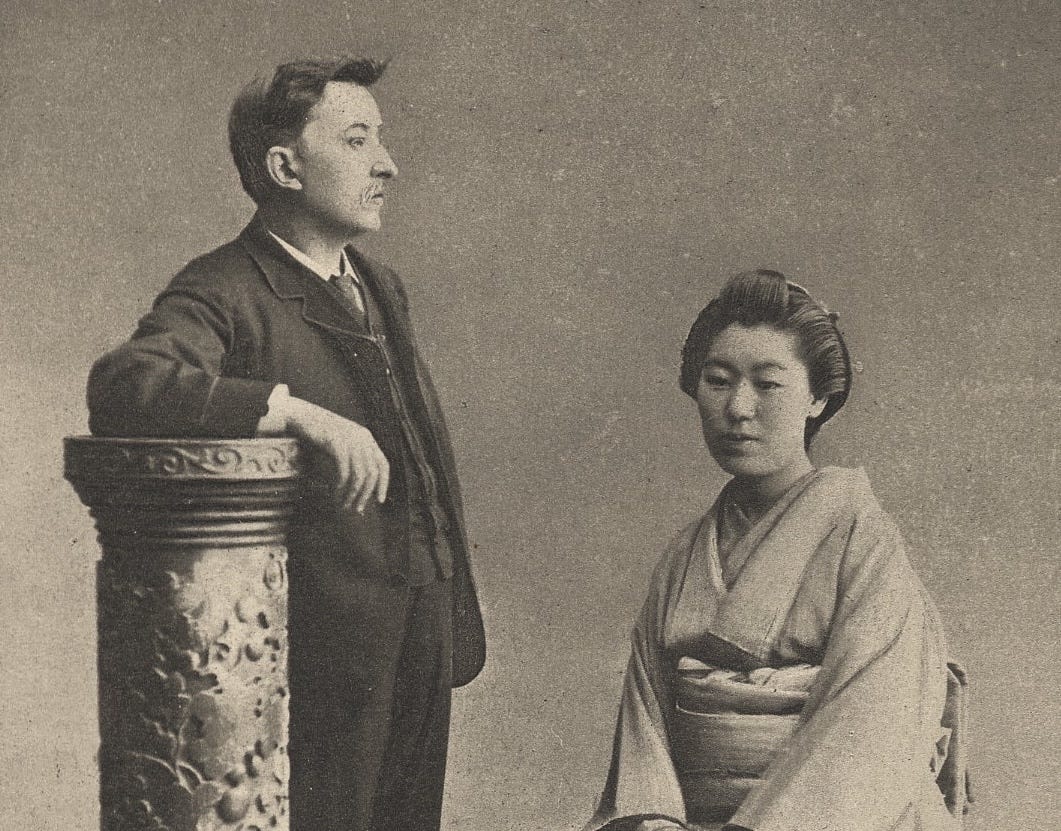
Lafcadio Hearn first met Koizumi Setsuko (‘Setsu’) when he was working as an English teacher in Izumo. He had previously been married to a biracial women born into slavery in Kentucky, although not much is known about their relationship.18 Blind in one eye, Hearn had requested that a samurai’s daughter come be his live-in housekeeper, to manage his affairs and teach him local customs. She was 18 years his junior and, like thousands of other families, had been impoverished by the Meiji economic reforms that broke up the samurai class. Given his proclivities, it is no wonder that Hearn requested his home help be a window into Old Japan.
There is a case to be made that what followed is the most well-documented interracial romance of the 19th century. Setsu never learned anything beyond rudimentary English, and the couple eventually learned to converse in a broken pidgin: ‘Hearn-go’. A decade after his death, Setsu wrote a moving memoir about her husband, and last year a well-received drama series about them on Japanese TV received millions of viewers.
In 1896, by being adopted by Setsu’s parents and taking her name, Hearn became arguably the first foreigner in Japanese history to be naturalised. This involved revoking his status as a British subject, and meant that their four children would have legal status and be able to inherit property.19
Becoming a citizen was apparently not enough to save Hearn’s job as professor of English at the Imperial University of Tokyo, the apex of his teaching career. The university dismissed its foreign faculty in 1903, in line with the ‘Japanisation’ reforms that were phasing out the role of Western advisors in building up Japanese industry and academia. In the university, Hearn lectured his students on the works of Swift, Burke, Yeats, and Synge, and inspired the creation of Irish literary societies in Tokyo and Osaka.20 His replacement was the esteemed Natsume Sōseki, whose novels are still widely read and acclaimed today for capturing the ‘spirit of Meiji’ and its complicated tradeoffs in a way that Hearn couldn’t or wouldn’t.
If writers like Sōseki did such a better job at capturing that spirit, then what is the point of Lafcadio Hearn? If both his political and religious theories are of little interest to modern readers, and if he all-too-often subordinated his judgment to them, should we conclude that Hearn is justly forgotten in the West today?
I say no. There is a version of Hearn’s ‘big idea’ that still resonates. As Japan became more familiar, he turned from his direct impressions of the country to folk tales – perhaps inspired by the Gaelic Revival, he was trying to save some of the Old Japanese culture that he believed was dying. He was particularly fascinated by kwaidan: ghost stories.21
The flip-side of the idea that you ought to venerate and follow the wishes of your ancestors, is the idea that something might go wrong if you don’t. Hearn, just as much as Spencer before him, emphasised that the evolutionary process that gave rise to ancestor-worship also produced humankind’s near-universal belief in (and fear of) ghosts.22 Chamberlain said that ‘no one could understand Lafcadio Hearn who did not take into account his belief in ghosts’ – or, more accurately, his belief in the belief in ghosts.23
Hearn would ask Setsu to scour the country and its bookshops for Japanese-language ghost tales. She would then retell the stories to him, often in bed where he would react with great verve and fear, which egged her on to make the material her own – gauging Hearn’s reactions to emphasise some parts of the story and downplay others. Hearn then took the stories she had told him and made his own changes, finally writing them down in the English prose style he had honed.24
Given this process of Chinese whispers, the stories are often not worth much in the way of cultural preservation. But that’s not the point: the point is that they are good stories. Hearn’s ghost stories are sometimes scary, sometimes bloody, but always weird and unsettling, inflected with his own distinctive personal voice, which often butts into the narrative at opportune moments.
Hearn’s ghosts are rarely to be welcomed. His own authorial voice states in ‘Of Ghosts and Goblins’ that ‘the coming back of the dead is never a thing to be desired. They return because of hate, or because of envy, or because they cannot rest for sorrow.’ Outside of his kwaidan writings, Hearn encourages proper reverence for the dead as the foundation of all ethics and social order. But in ‘The Story of Mimi-Nashi-Hōïchi’, the ghosts of the Heiké clan, who compel a blind bard to perform a song relating their story night after night, are draining his life force. The living have to respect the power of the dead, but also resist it. In the same story, the Heart Sutra is used as a magical talisman to ward off the ghosts – a far cry from Hearn’s official analysis of Buddhism, that it represents an embrace of our ‘race-memory’ of the dead.
The process by which they were written imbued Hearn’s kwaidan with all of the personal and intellectual concerns of Lafcadio Hearn himself. His interest in the stories was driven by nationalist assumptions about Japanese society, Gaelic Revival–style Romanticism, and Spencerian beliefs about evolution and ancestor-worship. But they were also filtered through his personal relationship with his wife and his own reactions of fear and excitement, and they were written in his own words with his own style.
Hearn’s work was filled with strange points of tension. He was a singularly individualistic freelance writer who insisted that the living should entirely submit themselves to tradition; an internationalist ‘citizen of the world’ who came to ally himself so deeply with nationalist politics; a believer in social evolution who nonetheless prized more ‘primitive’ traditions. In his own work, Hearn filtered all of these tensions through his ‘one big idea’, the fundamental question of how the living should relate to the dead. And only in his ghost stories is reverence for and worship of the dead properly balanced with fear of their power, of the dead hand of obligation and resentment.
Precisely because Hearn put so much of himself into the kwaidan, they (perhaps paradoxically) feel less burdened by his own assumptions and preoccupations. He allowed these stories to reflect the tensions that he himself felt with his ‘one big idea’, which he couldn’t put on show in his more analytical writings; and this diversity and open-endedness means they rely less on Hearn’s context and idiosyncrasies. His tightened prose style, his sense of horror and fear, and his deep concern with the ideas behind ghost stories all came together to produce tales where (as one critic put it) ‘the interactions between the living and the dead were determined not by some detached, metaphor-making sensibility but by the unruly passions of the dead themselves.’
And so the part of Lafcadio Hearn’s work that is still living – that has been adapted into a classic Japanese horror movie25 and given a Penguin Classics reissue – is that which is also most about the dead. His ambition was to interpret Japan for the West, and in this he largely failed: his Spencerian framework led him to mistakes that his contemporaries corrected and that history has not been kind to. But in the ghost stories, his rigid framework buckled under the weight of the tensions he was exploring. They remain genuinely uncanny, and absolutely worth reading.
Peter McLaughlin is associate editor of The Fitzwilliam and an Emergent Ventures winner. He writes the blog Her Fingers Bloomed. You can email him at peter [at] thefitzwilliam [dot] com.
Charles David Ewick, ‘Anglo-American Poetry and Japan, 1900-1950: A Critical Bibliography’, PhD Thesis (University College London), p. 494.
This claim is common in English-language sources on Hearn. The social studies curriculum published by Tokyo Shoseki appears to confirm it (though I am relying on machine translation), and I did come across a bit of corroborating anecdotal evidence: businessman Tony O’Reilly has reported that former PM Yasuhiro Nakasone, upon hearing Hearn's name, responded: ‘Ah, Koizumi: he made my childhood’. (O'Reilly, foreword to Sean G. Ronan (ed.), Irish Writing on Lafcadio Hearn and Japan, p. xi.) However, I have not been able to verify the claim independently.
As a representative example, see the story ‘Gibbeted’ that is included in the Library of America anthology of True Crime, ed. Harold Schechter, at pp. 117–130.
Hearn, ‘French in Louisiana’, in S. Frederick Starr (ed.) Inventing New Orleans: Writings of Lafcadio Hearn, pp. 161–162, at p. 161.
Hearn, letter to Basil Hall Chamberlain, 16 February 1894.
See e.g. Hearn, ‘French and Anglo-Saxon’, in Inventing New Orleans, pp. 159–161.
Quoted in Nanyan Guo, ‘Interpreting Japan’s Interpreters: The Problem of Lafcadio Hearn’, New Zealand Journal of Asian Studies 3 (2001), 106–118, at p. 107.
It is natural to interpret the protagonist of ‘A Conservative’ as a composite, a fictionalised portrayal of a general ‘type’ of person; but Hearn scholar Sukehiro Hirakawa has argued that, in fact, Hearn had a specific individual in mind, one Nobushige Amenomori. See Hirakawa, ‘Return to Japan or Return to the West? Lafcadio Hearn’s “A Conservative”’, Comparative Literature Studies 37 (2000), 196–211. But certainly Amenomori was representative of a broader trend towards conservatism in late Meiji Japan, and this was why Hearn chose to write about him.
Hearn, letter to Basil Hall Chamberlain, 11 October 1893; Chamberlain, letter to Lafcadio Hearn, 22 October 1893.
While he did actually read On the Origin of Species at least once, Spencer’s engagement with the details of Darwin’s work was extremely superficial. He was part of a wider trend of Victorian ‘evolutionist’ thinkers who used rhetorical appeals to Darwin to make their conclusions seem ‘scientific’, the inevitable product of advancing human knowledge – even as the substance of their arguments downplayed the essential Darwinian mechanism of natural selection and embraced Lamarckian inheritance. See Peter J. Bowler, The Non-Darwinian Revolution: Reinterpreting a Historical Myth. Hearn also used this rhetoric of scientific inevitability: in ‘A Conservative’ he calls Spencer’s theory ‘that Western science whose logic [is] irrefutable’.
See Hearn, Japan: An Attempt at Interpretation, appendix.
Herbert Spencer, ‘The origin of animal-worship, etc.’, The Fortnightly Review 13 (1870), 535–550. Spencer’s analysis was possibly drawing on earlier some insights of Adam Smith (compare The Theory of Moral Sentiments, I.i.1.13, II.i.2.4), though Smith had thought that the belief in ghosts and fear of death were human universals, not remnants of ‘savage’ superstition.
Spencer, The Principles of Sociology, part 5, ch. 14; Spencer, ‘Religious Retrospect and Prospect’, Popular Science Monthly 24 (1884), 340–351.
Hearn, letter to Basil Hall Chamberlain, April 1891. See also Hearn, Gleanings in Buddha-fields, pp. 91–92.
For a text where Hearn claims that ‘we Occidentals have yet to learn the worship of ancestors; and evolution is going to teach it to us’, see Hearn, letter to Basil Hall Chamberlain, April 1891. For a text where he argues that Japan will struggle to keep a hold of its traditions of ancestor-worship in the face of the forces of history, but that ‘statesmanship’ could and should preserve them, see Japan: An Attempt at Interpretation, pp. 453–456.
Starrs, ‘Lafcadio Hearn as Japanese Nationalist’, p. 190.
A representative passage can be seen in Hearn, ‘The Literature of the Dead’, in The Buddhist Writings of Lafcadio Hearn, pp. 103–147, at p. 126. The whole volume has useful examples of Hearn’s religious thinking.
The recent novel The Sweetest Fruits by Monique Truding reimagines Hearn’s life through the three most important women in it; Setsu, his black wife Alethea, and his Greek mother Rosa.
Hearn’s great-grandson now directs the Lafcadio Hearn Memorial Museum, a major tourist attraction in Shimane Prefecture. He has also visited Ireland and met his distant Irish relatives, which inspired the creation of the Lafcadio Hearn Gardens in County Waterford.
This is the argument of chapter four of Ancestral Recall: The Celtic Revival and Japanese Modernism by Aoife Assumpta Hart.
Kwaidan has kanji 怪談 (‘strange’ + ‘talk) and is romanised as ‘kaidan’ in modern Japanese. The older romanisation, with a ‘w’, is more common in publications of Hearn’s work today.
For details, see Hearn, ‘Nightmare-Touch’, in Shadowings, pp. 235–248.
The quote is by Elizabeth Bisland, paraphrasing Chamberlain: see The Japanese Letters of Lafcadio Hearn, p. lv. The fact that Hearn’s belief in ghosts was not fully literal, and was always filtered through the Spencerian idea of race memory, is emphasised by George Hughes, ‘W. B. Yeats and Lafcadio Hearn: Negotiation with Ghosts’, in (ed.) Irish Writing on Lafcadio Hearn, pp. 188–203.
The process is discussed in Setsuko Koizumi, Reminiscences of Lafcadio Hearn, ch. 2.
We were sent down this fascinating rabbit hole by a screening in Dublin of the 1964 Masaki Kobayashi film adaption of Kwaidan at the Bram Stoker Festival. Sam Enright reviewed it in his Links for November; it’s definitely worth a watch.
Fantastic essay!