


TL;DR: Ireland’s final end-of-school exams, the Leaving Certificate, are being reformed. For maths in particular, we believe the new curriculum, if implemented, would be catastrophically bad. Prominent bodies representing mathematicians in Ireland have started to organise statements about its many problems, and we have an open letter of our own at savemaths.ie. If you are persuaded by our arguments, and especially if you have any influence over Irish education policy, we encourage you to sign the letter.
Last month the National Council for Curriculum and Assessment, Ireland’s national body for teaching and examination standards, released the new draft specification for Leaving Certificate mathematics.1
If this draft (or something like it) is implemented, it could destroy quality mathematical education in Ireland. We fully realise that sounds like absurd hyperbole. But in the words of Professor Pauline Mellon, a member of the NCCA’s mathematics committee who resigned this year:
This draft curriculum should not be progressed. If it, or a variant of it, is adopted, it will significantly harm mathematics education and disadvantage the tens of thousands of students who will take it each year. It will further reduce us in international comparisons and will lead to a reduction of standards for third- level courses requiring quantitative skills, with knock-on consequences downstream for many key industries.
We think she is right, and indeed the new documents are perhaps even worse than she says. It is not just that they are littered with mathematical errors, although they are. If they are implemented, the abilities of Irish students will be called into doubt by the world’s best universities and employers. Ireland’s reputation as a place where businesses can access genuinely skilled workers will be threatened.
This is happening as part of a wider reform to the Leaving Cert. There are many other worrying trends in these reforms, which we were originally planning to write about. But the draft maths specification is so bad, and could have such disastrous consequences, that we’ve had to refocus our attention. These issues cannot be fixed via the usual process of consultation: the government must urgently step in to stop this draft spec from being progressed, and send the NCCA back to the drawing board, with clear instructions to follow the advice of mathematicians.
Table of contents
40% of exams will be replaced by a subjective ‘event’
The biggest and most dangerous change of all has to do with how Leaving Cert maths will be assessed. Under the proposals, at the end of fifth year, students will take part in a one-day ‘Investigating with Mathematics’ event where they will ‘consider a real-life issue with Mathematics’.
The assessment does not only, or even primarily, assess students on the mathematical accuracy and logical validity of their answers. Instead, students will be graded on such things as their ability to ‘provide clear accurate interpretation’ or ‘identify all key features of [a] visual pattern’. These criteria will be graded against verbal and qualitative descriptors, instead of a rigorous marking scheme. And instead of being given numerical marks, students will be assigned one of three possible bands per criterion: ‘High’, ‘Moderate’, or ‘Low’. This will be 40% of their grade.2
If this is implemented, this could destroy the reputation of Leaving Cert mathematics. The problems are many:
It is subjective and thus gameable. Teachers who are ‘in the know’ about how the examiners approach this task will be able to coach their students to meet the subjective criteria, getting them to ‘jump through hoops’ without actually showing any original mathematical ability.3 This is exactly what happened when England experimented with non-exam assessment in GCSE maths (the equivalent of Ireland’s Junior Certificate, ages 14–16). England eventually scrapped the non-exam assessment after hard experience; Ireland should take advantage of our neighbour’s experience and scrap it now, without having to go through the trouble ourselves.
Marking will necessarily be crude and simplified. When the only options are ‘High’, ‘Moderate’, and ‘Low’, there’s no way to make a distinction between good students and truly excellent students: both are ‘High’. And on the other end: in an exam setting, struggling students can still get marks for effort and attempts to solve problems, even if they don’t get the right answer. But it is hard to see how, under this new system, these students will not be bucketed together with students who don’t try at all: the only option for them is ‘Low’.
It will be unreliable. Subjective rubrics produce a wider range of results than strict marking schemes: different examiners rarely disagree over whether a student’s calculation was correct, but they will inevitably disagree over how well students ‘identify features of a pattern’. With 60,000 students sitting Leaving Cert maths every year, even a small divergence between examiners could result in thousands of students being mismarked.
It will be just as stressful for students as an exam. We know that exams are stressful; one of the main purported benefits of non-exam assessments is that they reduce pressure on students. But ‘Investigating with Mathematics’ is a one-day event under quasi-exam conditions, worth 40% of the grade; it’d be just as stressful. It would diminish academic standards without even giving students a reprieve.
But, most importantly, it assesses the wrong things. A student whose mathematical reasoning contains mistakes, but who submits a visually polished report with lots of nice charts, could get a ‘Moderate’ in ‘Mathematical reasoning’ but a ‘High’ in ‘Communicating the findings’. A student who spends a lot of time ensuring their maths is impeccable, and so has less time to add charts and nice visuals, could get a ‘High’ in ‘Mathematical reasoning’ but only a ‘Moderate’ in ‘Communicating the findings’. These two students could get the exact same grade, even though one of them showed more skill in mathematics: the other one made up for it using their skill in producing pretty Word documents.4
Maths assessments should not measure personal confidence or communication: they should measure mathematical ability. But if these reforms go ahead, a high mark in mathematics would no longer be a guarantee that a student is actually good at maths.
A middling student could get lucky with a kind examiner for ‘Investigating with Mathematics’, be coached effectively by their teachers, and offset their mathematical weakness with nice charts or effective communication or an eye for visual ‘patterns’.
Meanwhile, if a really hard-working and mathematically gifted teenager had teachers who object to ‘coaching’, a harsh examiner, and/or a weakness in non-mathematical skills, they’d be hamstrung. They could plausibly end up with 74% or less on ‘Investigating with Mathematics’, and it would be literally impossible for them to get a H1,5 no matter what they did in sixth year—even if they got a perfect 100% in every single exam.
The decision to implement non-exam assessment for maths was not made on the basis of solid evidence, or the opinions of experts. It was a ministerial decision made in 2022 by a previous Education Minister, before the maths subject group even convened. ‘40% non-exam assessment’ was the blanket rule applied to all subjects, without detailed examination of the appropriateness of this rule in different contexts.
It’s worth noting that the first version of this policy that was announced had to be abandoned very quickly, because the release of ChatGPT combined with the relatively lax controls on the non-exam assessments produced, essentially, an open invitation for AI-enabled cheating. This should have been taken as an opportunity to rethink the suitability of a blanket rule like this; unfortunately, only minor tweaks were made.
This rule arguably makes sense for some subjects, especially in the humanities. But maths is different, for two reasons:
In many humanities subjects, there is just no alternative to somewhat subjective rubric-based assessment. But in maths, we actually have a rigorous and objective way to mark. We should be using it.
At least in a subject like English, the subjective assessment is trying to assess students on their English skills. The worst issue with ‘Investigating with Mathematics’ is that students will be graded on communication, visual aesthetics, and many other things that aren’t mathematical ability.
The current Leaving Cert is imperfect, but it is trusted by employers and universities because it does a pretty good job of measuring mathematical ability. ‘Investigating with Mathematics’ would destroy this trust.
Important content has been gutted, and nothing added in its place
‘Investigating with Mathematics’ would be bad enough on its own. But—perhaps to make room for the inevitable coaching—the examined portion of the course has also been cut to the bone.
Some of the most important content on the old maths spec has been removed completely. In particular, all material on complex numbers has been cut, as well as all mention of proofs by induction, and all geometric proofs. This is not just a random assortment of topics: these are the first places in the course where students get the experience of ‘higher’ mathematical reasoning.
What do we mean by that? Well, before Leaving Cert, maths education is focused on relatively concrete topics that most people have some understanding of: number and shape. But the kind of mathematics that is actually taught in universities—and which you need for many tech and science and engineering jobs—relies on the power of abstraction: defining and investigating new concepts and structures, like the complex plane, that might not come from everyday experience but which are extremely powerful tools for solving problems.
Likewise, most school maths is about calculation, and this is certainly a big part of maths. But even more central is the idea of proof: rather than just calculating an answer in a specific case, you demonstrate (beyond doubt) that all problems like this have such-and-such an answer; or, rather than just uncritically applying a formula, you show why the formula is true, and get a deeper understanding of how it works.
The draft documents pay lip service to these ideas. But by cutting abstract topics like complex numbers, and proofs in both geometry and number theory, the proposed reforms would leave students with no training whatsoever in abstraction or proof. Statistics—another centrally important part of modern mathematics—would also not be examined at all.
Perhaps other material has been added to make up for all this? No: there are no major new topics on the spec.
Well, perhaps old topics are being investigated in more depth? Again, no. If you were forced to be as kind as possible, you could maybe say that the treatment of integration at Higher Level is slightly more detailed than it was before. But even then, these changes take up only one page of the 70-page spec.6 Every other topic is either unchanged, or (more often) has actively been dumbed down—statistics, sequences and series, trigonometry, etc.
And it’s worse than that. Even where the content has not been dumbed down, the way students are taught the content will change dramatically: in about a dozen topics, it is no longer expected that students will solve problems themselves. Students learning about these topics, from functions to optimisation to synthetic geometry, will instead be explicitly given the answer, and just have to double-check it. Genuine, open-ended problem-solving is no longer a requirement.Synthetic geometry on the new proposed spec. Students merely have to ‘justify proposed solutions’ given to them by examiners.
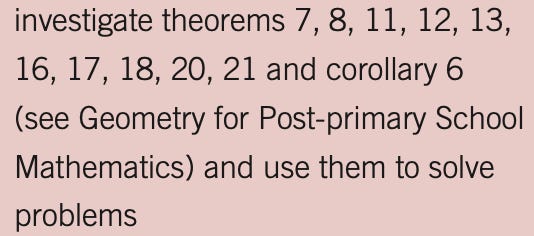
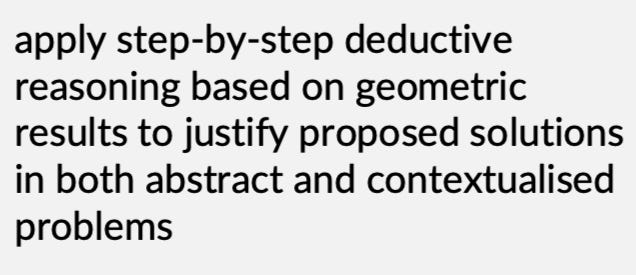
You might think we are being excessively uncharitable, given the ambiguity of the term ‘justify’. But using the term as the glossary of the document intends, it is hard to avoid the conclusion that students are going to be taught merely how to come up with post-hoc explanations of facts they are told. From experience, this is inimical to deep mathematical understanding.7
These changes would be disastrous
If these reforms were implemented, the immediate result would be that we would lose the ability to identify students who have strong mathematical ability.
Employers and overseas universities would place much less trust in Irish qualifications; the inevitable result is that they would accept or hire fewer people from Ireland, and multinationals would be less willing to bring technical jobs to Ireland. Meanwhile, Irish universities would be unable to select the most capable students: the Leaving Cert would not be a good enough signal of a student’s abilities. The quality of cohorts in technical subjects would drop, and our universities would struggle to keep up in international academia.
But the longer-term effects would matter even more. It’s not just that we’d lose the ability to identify people with strong maths knowledge: over time, Ireland would just have fewer such people. We would end up with a population with weaker mathematical skills, and lose our standing as a country known for its highly skilled technical workforce.
In the first place, this is just because our students would be taught less content. If topics like complex numbers don’t appear on the Leaving Cert, it’ll be down to university and college lecturers (already spread thin) to dilute their courses even more to make room for a few hours dedicated to these topics—topics that really need several weeks or more of dedicated attention. Inevitably, Irish people will leave university with less understanding, and a weaker grasp of the ideas, and be less able to apply them.
But more insidiously, ‘Investigating with Mathematics’ would reduce the incentives teenagers have to work hard at maths. In the first place, lots of the effort that smart and hard-working kids are currently putting into learning maths, they would have to redirect towards improving the non-mathematical skills that are now being assessed. But also, weaker students would be able to pick up marks through ‘Investigating with Mathematics’, and so would be under less pressure to learn maths to get the marks they need for university. Everyone will lose out: at the top end, talented and hard-working kids will have less reason to focus on the core competencies of the subject; at the other end, the punishment for not working hard at mathematics will be lessened.
To see the kind of effects that ill-thought-out reform can have, we can look to Scotland, which in 2010 made a radical overhaul to its school system, the ‘Curriculum for Excellence’. In the intervening sixteen years, Scottish students have fallen behind by the equivalent of eight months of reading, 14 months of science and 19 months of mathematics. Let’s repeat that: being taught the Curriculum for Excellence instead of the old Scottish curriculum is the equivalent of missing a year and a half of maths.
The knock-on effects in higher education have been huge. Scottish kids, especially the poorest, are not getting a good enough education for university: only a quarter of students at Scotland’s leading universities are actually Scottish. And we can expect that the effects on the job market, and Scottish society more generally, will start to accumulate in coming years, as students educated under the new system come to make up a larger proportion of the population.
The same point can be illustrated with dozens of examples, from Quebec to Japan. Ill-thought-out changes to a country’s school system, and especially to maths education, can have a hugely damaging effect on mathematical skills and knowledge.
Generally speaking, Leaving Cert points are the sole determinant of what a student is accepted to study at university.8 Curriculum design is the central question of Irish education policy.
Ireland needs mathematical knowledge
Some might ask: would this even matter?
Sometimes people try to distinguish (a) practical ‘numeracy skills’ that students will use in the wider world, from (b) the kind of formal, often-abstract maths that is done in universities. And they argue that schools should focus on (a) to prepare our teenagers with the skills they will actually need. The draft specs show a lot of evidence of this kind of thinking: the implicit idea seems to be that abstract mathematics is not that important, and it wouldn’t matter if the Irish population lost some knowledge in this department, so long as our kids have broad ‘skills’ and are prepared for the real world.
One response to this line of thinking is that, even if abstract maths were not practically relevant, it is important to be exposed to it in a well-rounded civic education. After all, most people don’t need to have read Shakespeare for their jobs, but we as a society want citizens who have some familiarity with his works, which are among the greatest achievements of world literature. Likewise, practicalities aside, we as a society should want citizens who have some familiarity with ‘higher’ mathematics, which includes some of humanity’s greatest and most beautiful intellectual achievements.
We agree with this. But there’s also a more hard-headed response: many of students will practically use ‘higher’ maths in the wider world—if they are actually given the opportunity to learn it.
Ireland aims to have an economy with heavy reliance on technical sectors like engineering, science, pharma, software, etc. These are sectors that demand abstract, formal, technical mathematical knowledge. Complex numbers are vitally important problem-solving tools for all sorts of engineering jobs. Scientific research jobs in pharma and other sectors demand a strong familiarity with statistics.
Modern AI is built on linear algebra—vectors and matrices—a topic that was entirely removed from the maths curriculum a decade ago. This is especially ironic, given all the buzz in education circles these days about the need to prepare students for the age of AI.
Ireland needs these skills for its economy, and many Irish students need these skills for their future jobs. We should be adding topics like vectors and matrices back in, not stripping even more topics out.9
The point goes deeper than just jobs. The modern world is increasingly reliant on extremely complex and specialised technologies. For a modern country, having a cohort of citizens who are able to understand these technologies isn’t just a nice-to-have: it is essential if we want to actually shape the trajectory of these technologies, to ensure Ireland has the ability to shape its own future. Saying maths knowledge is good for jobs is correct, but it’s a bit like saying we teach kids how to read and write so they can get jobs. It’s partly true! But there’s also a deeper reason: a country without a literate population cannot be an advanced society at the forefront of international affairs. The same is true of mathematics.
Those worried about AI often point to an ongoing or future ‘cognitive collapse’, in which a lack of environments in which one is forced to think for oneself undermines human intelligence. We can’t help but feel that these reforms will only accelerate this trend.
The process that produced this draft is broken
The documents published by the NCCA are so bad that, even if they had been produced by an impeccable, transparent, and consultative process, the Government should still scrap them. But in recent weeks we’ve seen highly concerning revelations about the process followed by the NCCA.
Two of the experts on the NCCA’s maths committee—Professor Pauline Mellon of UCD, and Dr Aoibhinn Ní Shúilleabháin of DCU—have resigned, unwilling to be associated with the draft curriculum. Their testimony is extremely worrying.
Dr Ní Shúilleabháin’s statements especially suggest that there was little scope for expert input into the shape of ‘Investigating with Mathematics’: ‘conversations were limited to … shoe-horning assessments into a format that does not make sense’. Certainly, there seems to have been no scope for experts to argue that it should be scrapped.
More generally, NCCA staff seem to have treated expert consultation as a formality, rather than something that should substantially influence the specification. Dr Ní Shúilleabháin has written that ‘group decisions were not always recorded, handpicked opinions appeared in drafts and input from some members was consistently ignored.’ The claim that group decisions were not actually recorded is consistent with the extremely short, bland, and uninformative minutes that are available for the maths committee’s meetings.
One particularly worrying piece of testimony came from Prof. Mellon, who told RTÉ that members of the maths committee were not actually provided with the responses to an earlier consultation. Instead, they were provided with a ‘summary’ written by the NCCA that purported to represent the gist of consultation responses; but when committee members asked to see the full responses, to understand some points more fully and check if the ‘summary’ was accurate, the NCCA refused.
(As an indication: in the case of science subjects, the NCCA also refused to provide the original consultation responses, but these were later published under the Freedom of Information Act. We have looked at these responses and agree with the Irish Science Teachers’ Association: the NCCA’s ‘summary’ document bears little resemblance to the actual consultation responses.)
Finally, and most blatantly, the draft specification is full of mathematical errors. Obviously, mistakes happen when a complicated document is being drafted and redrafted by many hands; this is inevitable. But the very worrisome thing is that both Prof. Mellon and Dr Ní Shúilleabháin testified that they (and other committee members) noticed the errors, tried to get the NCCA to fix them, and were ignored. These are not the normal, understandable mistakes that are inherent to a document like this; they give us good reason to be worried about the process.
Is it possible that these ‘errors’ were just attempts to simplify complicated concepts for students? We hope not. We have gone through the draft specification and have found many of these errors (we list a few of the most prominent in an appendix below); many of them are extremely basic and crude. If the NCCA think this is an appropriate level of simplification for 18-year-olds, this would be extremely concerning: it suggests that, as Prof. Mellon has said, they want to ‘make mathematics friendlier by making it less mathematical.’10
In short: mathematicians have been ignored; consultations have been misrepresented; and, worst of all, glaring mathematical mistakes have been retained, against the judgement of experts.
All of this has led to an emerging consensus in Irish media over the past weeks that something needs to be deeply reformed about this process. That the implementation should be paused is now the official view of The Irish Times.
Ministers need to intervene
It should not be a surprise that, since the documents have gone out for consultation, the proposed reforms have been mired in controversy. One of the most important developments has been an open condemnation of the draft spec by the Irish Mathematical Society.
In response, the NCCA have tried to emphasise that this is a draft specification, out for consultation, and that there is a process of engagement by which it can be improved.
The issue with this argument is twofold. First: we have seen how the NCCA handles consultations; it does not inspire confidence. We know that NCCA staff have, inadvertently or willingly, misrepresented consultation responses; that they have failed to take on board the views expressed in consultations; and that they refused to reveal the full details of consultation responses to experts. Experts testify to feeling railroaded towards the NCCA’s pre-made decisions. Two mathematicians have resigned, precisely because they do not trust that the consultation will improve this.
Second, and more importantly: even if we trusted the NCCA’s processes more than we do, there is no amount of tweaking this document that could produce a good specification. It is too fundamentally flawed: hollowed-out, dumbed-down, and badly assessed. It does not reflect any sense of what mathematics is, or why it is a significant and important subject, or how it should be taught and assessed in a technologically advanced and ambitious country like Ireland.
Thanks to the backlash, we expect the NCCA will fix the most blatant errors. But the basic structure of the spec will remain the same, unless something is done about it at the ministerial level. Allowing this document to progress in any form would be bad for Irish mathematics and bad for Ireland.
The Government has broad powers under the Education Act 1998 to take charge of the Leaving Cert reform process. The Education Minister has final say over the curriculum; the NCCA’s role is technically advisory. The Minister can choose who to consult, set up a parallel advisory body, and overrule the NCCA.
There is recent precedent for this: in 2025, the previous Education Minister Helen McEntee intervened to make sure Shakespeare stayed on the English course; and in 2019, then-Minister Joe Higgins made a sweeping rejection of the NCCA’s recommendations about the place of history at Junior Cycle.
Our recommendation is simple. The Education Minister must scrap the draft maths spec entirely. She should use her powers under s. 30(3)(b) of the Act to establish a new group of expert mathematicians and others—entirely independent of the NCCA’s processes—who should work together with the NCCA to produce a new specification, and who (in case of a conflict) can provide their own advice and recommendations directly to the Minister.
This group should have wide freedom to suggest what they think would be the best approach for Ireland—which will require the Minister to change the blanket rule that she inherited from her predecessor, that all subjects must have 40% non-exam assessment.
A U-turn like this would be painful, both for the NCCA and for the Government. It would require political courage. But the risks of letting this specification progress are just too great. If Ireland is to continue to be a rich, advanced, technical country punching above its weight, then we need technical expertise. And technical expertise needs rigorous mathematics education. This specification could destroy Irish maths education for a generation; it must not be progressed.
Sam Enright is editor-in-chief of The Fitzwilliam, and Innovation Policy Lead at Progress Ireland. You can follow him on Twitter here or read his personal blog here.
Peter McLaughlin is associate editor of The Fitzwilliam. You can read his personal blog here.
Appendix: Mathematical errors in the draft specification
These are a number of the errors we found in the draft documents published by the NCCA. They are not the only mistakes we found, and we are certain there are other mistakes we didn’t spot; the list is just to give a flavour.
On the Higher and Ordinary Level spec:
Page 17 discusses “rational expressions of the form (ax + b)/(cx + d) ± (px + q)/(rx + s), where a, b, c, d, e, f, p, q, r ∈ ℤ”. There is no e or f in the expression, but s—which is in the expression—is undefined and unconstrained.
Page 22 says that students should learn that P(A | B) ≠ P(B | A); but this is not true if A and B are mutually exclusive, or if they are equally likely.
Page 31 says that students should understand the ‘application of axioms 1–6’ of Euclidean geometry. Famously, there are five axioms of Euclidean geometry; indeed, the document Geometry for post–primary school mathematics, explicitly referred to in the draft spec, has five axioms, and axiom 6 does not exist.
Page 37 says that the central limit theorem is what ‘justifies generalising from a sample to a population’. But what justifies this is taking a random sample; the CLT is a much more specific claim about the distribution of sample means of i.d.d. variables.
Page 49 claims that rational functions k/(ax + b) are “defined for all x ∈ ℝ”. In fact they’re undefined when x = -b/a.
Page 55, which is the Ordinary Level spec, defines the inverse of a function in terms of the equations (f ∘ f−1)(x) = x and (f−1 ∘ f)(x) = x. These equations are correct, but they rely on the symbol ∘, representing function composition—and this is not on the Ordinary Level spec, only Higher Level. Ordinary Level students would be taught these equations without ever knowing how the symbol ∘ works.
On the Foundation Level spec:
Page 15 requires students to translate between:
alternative representations of rational numbers
decimal notation and scientific notation
1/a, an, √a, ∛a, n ∈ ℕ
But while the first two are fine, the last list isn’t different ways of writing the same number; it is a list of (what are generally) different numbers. A student who ‘translated’ from √a to ∛a would be incorrect.
Page 19 claims that ‘The diameter of a circle [is] a special line through the centre from circumference to circumference.’ Technically, the diameter of a circle is a segment, not a line: in mathematics, a ‘line’ is always infinitely long. The very same page requires students to know the difference between lines, segments, and rays.
The most basic error of all comes on page 36—talking about the assessment of the Leaving Cert itself—which says that assessment ‘involves a written examination worth 40% of the available marks and an additional component worth 40%’. This, of course, does not add up to 100%.
Individually, each one of these sounds like a nitpick, or drawing unnecessary attention to a typo. We would agree, were it not for the case that (a) there is an error or oversimplification in a significant fraction of all mathematical expressions in the document, and (b) given all our arguments above, we struggle to believe that actual mathematical expertise is behind it.
It is currently out for public consultation, from 20th August until 18th November.
It’s not even fully clear from the spec if ‘Investigating with Mathematics’ will be a group task. Most likely it will not be (especially based on Junior Cycle precedent), and certainly we hope that 40% of Leaving Cert maths grades won’t come down to a group project; but the spec is so unclear that the public really has to rely on hope. There is a reference to a supplemental document, Guidance to Support the Completion of the Investigating with Mathematics Tasks, but this doesn’t publicly exist yet.
This is exactly what happened when England experimented with non-exam assessment in GCSE maths (the equivalent of Junior Cert, ages 14–16): students were being taught how to ‘jump through hoops’ to meet the criteria, rather than actually being taught maths. England eventually scrapped the non-exam assessment after hard experience; Ireland should take advantage of our neighbour’s experience and scrap it now, without having to go through the trouble ourselves.
This is assuming that the various rubrics (like ‘Communicating the findings’ and ‘Mathematical reasoning’ etc.) are given equal weight. Again, maybe the guidance will say otherwise; but the public currently has no way of knowing. And ultimately, even if the most subjective rubrics (e.g., the ones to do with formulating questions and communication) are given less weight, they will be given some weight; and even the least subjective rubrics are still very subjective and crude.
Further, some topics have been sufficiently diluted at Higher Level that they are now suitable for Ordinary Level, and so in places the syllabus is the same between the two where previously it differed (e.g., ‘Deductive reasoning in geometry’). Technically this is additional content at Ordinary Level, but (a) it’s not genuinely new content, it’s old Higher Level content that’s been simplified enough to cross the boundary between Higher and Ordinary; and (b) anyway, room has been made for this ‘new’ content by cutting even more topics from Ordinary Level.
In the few places where students are still expected to come up with solutions on their own, the spec makes it explicit, and uses the verbs ‘to find’ or ‘to solve’ as well as ‘to justify’. So the clearest meaning of ‘proposed solutions’ is ‘solutions proposed by the examiners’, not ‘proposed by the student themselves’. See also U2 (pp. 13–14) and the definition of ‘justify’ in the Glossary (p. 70).
There are some edge cases, like that schools from socially disadvantaged areas (DEIS schools) face a lower points threshold to be accepted to a college course. There is also a small number of courses, especially for art, that are based primarily on a portfolio or interviews.
Everyday numeracy (stuff like basic finance and probability) should perhaps be the focus at Foundation Level. But at Ordinary Level—and certainly at Higher Level—mathematics education should be focused on teaching mathematics.
The Education Minister, Hildegarde Naughton, responded to an RTÉ question about these errors by saying ‘I’m assured that there are no errors in it.’ We understand that a minister’s life is busy, and we expect she just had not had a chance to review the specific errors, and was relying on the NCCA’s word for it. But we hope she does take the time to review them herself, because it is beyond question that these are errors, very crude and basic mathematical inaccuracies.
The Philistine Ascendency holds nothing sacred.