

Ireland has one of the highest concentrations of AI engineers in Europe, but almost no frontier AI research.
Thousands of machine learning practitioners work in Dublin’s multinational tech offices, building products for Google, Meta, Apple, and Microsoft. Yet Ireland produces fewer papers at top AI conferences than any comparable developed nation.
At last December’s NeurIPS in San Diego – the largest annual machine learning research conference – I organised an Irish in AI meetup to understand the challenges facing the Irish AI research community. What struck me most was how small the Irish representation was. Irish research groups contributed three papers to the proceedings, while Switzerland contributed over 150.
What would it take for Ireland to build an AI research ecosystem like Switzerland’s? Over the past decade, sustained investment in high-performance computing has turned the Swiss National Supercomputing Centre into one of Europe’s most capable open-science facilities. Its Alps system anchors a dense network of academic and industrial partnerships, supporting everything from large-scale climate simulations to the training of multilingual language models. By contrast, Ireland’s national high-performance computing (HPC) system, Kay, was decommissioned in 2023, and replaced with a patchwork of international arrangements to continue serving Irish research compute needs.
Ireland’s AI research output is remarkably low for a country of its talent and wealth. The absence of a national research computing infrastructure makes this worse, and the recent efforts to address the gap fall short of our peers. Other small countries have signposted ways we can do better.
Ireland’s AI talent: world-class engineers, minimal research output
Independent rankings of Europe’s AI talent consistently place Ireland near the top. LinkedIn’s analysis of more than 30 million profiles concluded that Ireland has the highest density of AI talent in the EU on a per-capita basis. Sequoia’s Atlas reached a similar conclusion. My own count of LinkedIn profiles listing PyTorch, a standard machine learning programming framework, tells the same story, with roughly 64 per 100,000 residents, effectively on par with the United States (66) and ahead of the UK (50).
These figures should be treated with scepticism; they rely on self-reported skills and job titles. There are methodological issues with these rankings that haven’t been fully unpacked. But, broadly, the picture is consistent: Ireland has a large engineering workforce in AI-adjacent roles.
What these figures estimate, however, is engineering capacity, not research output. The Paper Copilot dataset tracks accepted papers across NeurIPS, ICML, and ICLR from 2020 to 2025. These three conferences are not the only place important AI research is published, but they are widely regarded as the top venues in machine learning, and comparing national contributions at them is a reasonable proxy for frontier research output. Normalised by population in the most recent proceedings, Ireland sits last among comparable small nations:
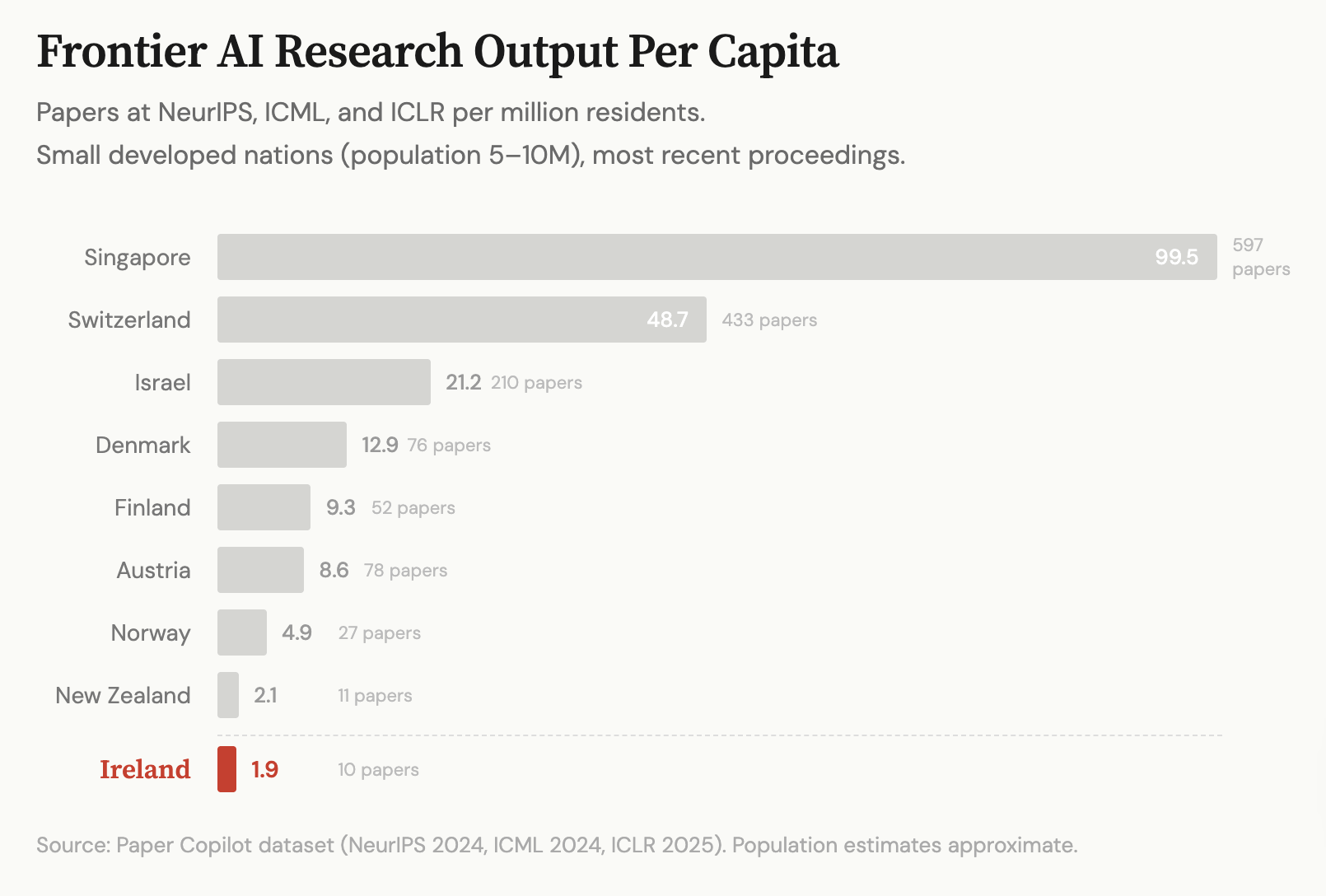
This pattern holds across multiple years of data. The contrast between Ireland’s engineering talent density and its research output is, as far as I can tell, unique among developed nations. For every thousand PyTorch practitioners, Ireland produces roughly three papers at top AI venues, compared to 26 in the US, 32 in the UK, and 61 in Switzerland.
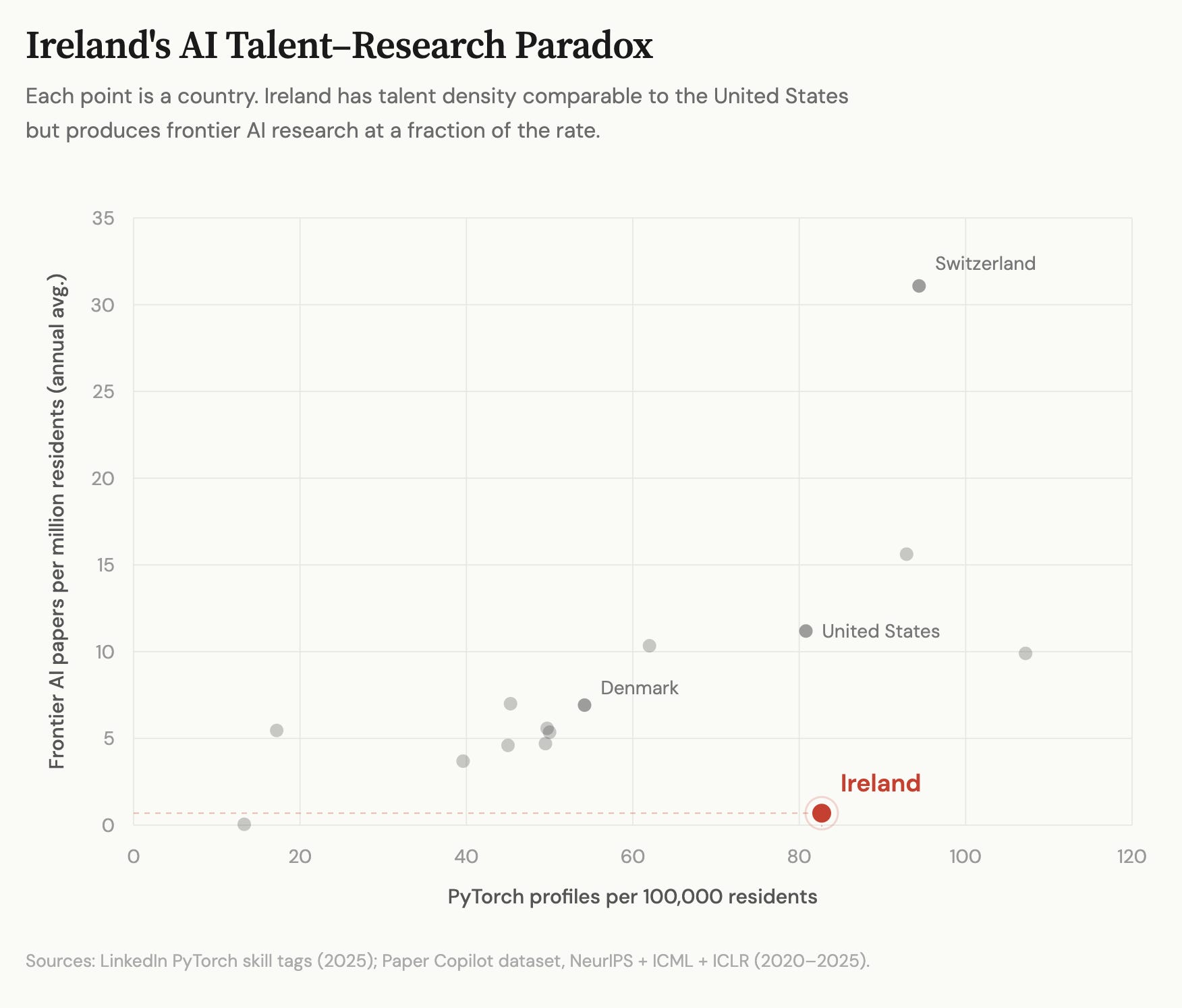
Why does Ireland convert so poorly? Ireland’s AI talent is overwhelmingly concentrated in multinational industry, whose work does not typically produce academic publications. The pattern holds even at the frontier labs themselves: OpenAI and Anthropic have both opened Dublin offices, but the roles they recruit for there are deployment, support, sales, and applied engineering. Their European research hiring is concentrated elsewhere: Anthropic’s London office houses over 60 AI safety researchers and is described by the company as “one of [its] most important research and commercial hubs outside the US”. OpenAI described its London hub in similar terms. And while Ireland has one of the highest ML practitioner densities in Europe, CSRankings lists only 25 ML-active faculty across all Irish universities, compared to 90 in Denmark.
One further dimension stands out: to the best of my knowledge, Ireland is the only developed country producing AI research at top venues without national HPC infrastructure.
Ireland’s rented AI infrastructure
Ireland does host substantial computing facilities. Amazon Web Services, Microsoft, Google, and Meta all operate data centres in the country. These companies do not disclose how much of their computing physically occurs in Ireland. You could try to calculate it based on the energy usage of the data centres, but without knowing how much of that energy is actually used for compute and what kind of hardware is used and how energy-intensive it is – none of which is publicly disclosed – the error bars are enormous.
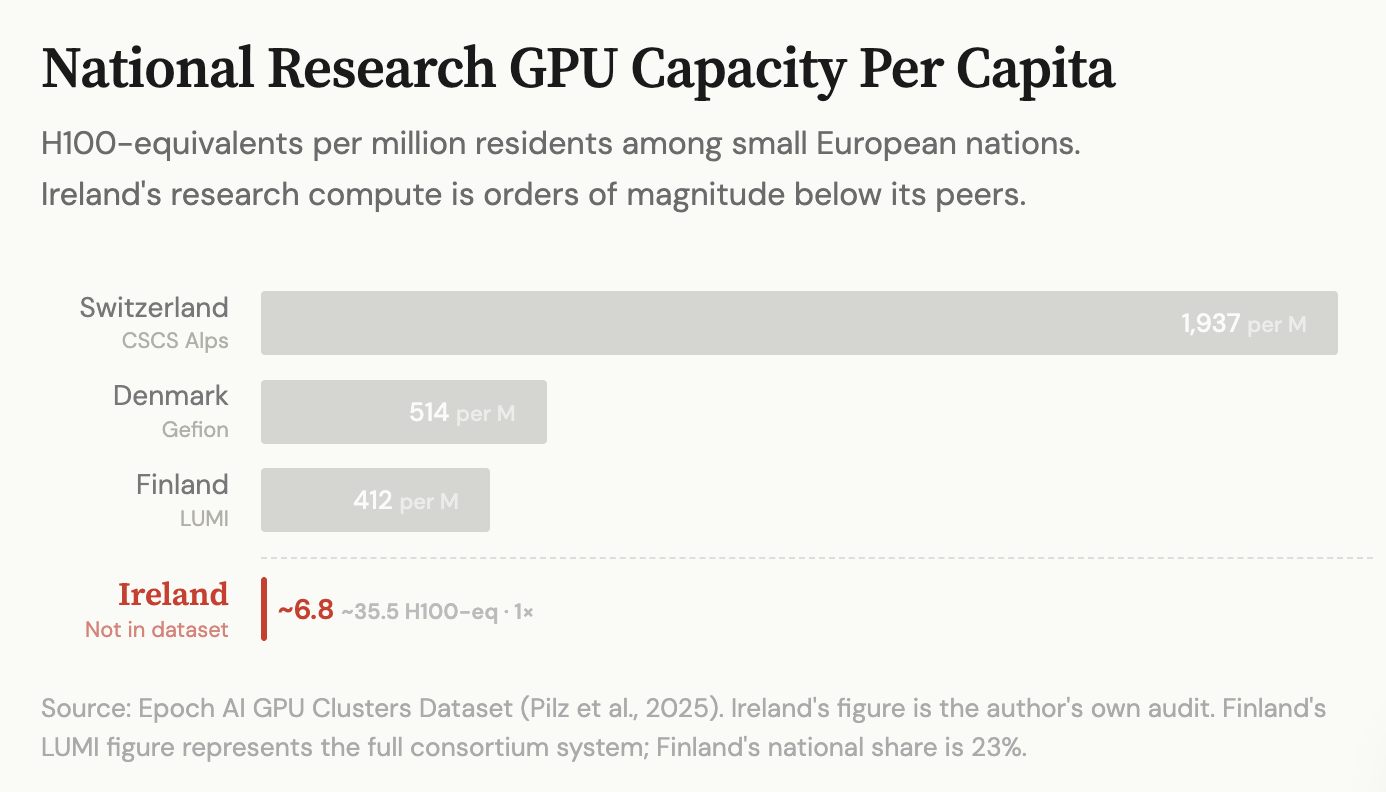
A standard unit for comparing AI computing power is H100-equivalents, based on Nvidia’s H100 chip. My own audit of Irish university and research centre websites suggests a total of roughly 35 domestically held H100-equivalents available for open research (see appendix), a figure that likely misses some labs but is unlikely to be wildly off.
Epoch AI maintains the most comprehensive global tracker of GPU clusters, a database of 786 systems across 37 countries. Systems must exceed roughly 1,000 H100-equivalents to be included. Ireland has no entries: its research clusters are far below this threshold, and the multinational data centres physically located in Ireland are general-purpose cloud facilities, not the dedicated GPU clusters the dataset tracks. Ireland’s research compute is a fraction of what comparably sized countries provide.
This gap between commercial and research compute is missed by international benchmarks. Stanford’s HAI Global Vibrancy Index ranks Ireland 19th out of 31 countries on AI infrastructure, but its infrastructure metric relies on Top500 data, which does not distinguish between commercial data centres and research infrastructure. Ireland’s only Top500 entries are industry systems; no Irish research system appears on the list.
So where do Irish researchers actually get their compute? The picture, assembled from conversations with colleagues and publicly available data, is one of fragmented dependence on foreign providers supplemented by modest domestic resources. Ireland rents time on Luxembourg’s MeluXina system through the Irish Centre for High-End Computing (ICHEC) as an interim arrangement following Kay’s decommissioning. Met Éireann, Ireland’s meteorological service, does not operate its own supercomputer; since 2023, it has participated in a joint Nordic HPC consortium hosted in Reykjavík. Some researchers receive credit grants on commercial cloud platforms like AWS. EuroHPC offers GPU-specific allocation pathways through public access calls, but Irish research groups have not yet secured any GPU allocations through these calls.1 Domestic university clusters supplement these arrangements at modest scale. The full picture is difficult to assemble – there is not a single public accounting of how Irish researchers access compute.
Some reliance on offshore allocations and cloud rentals is normal. What is unusual is for a country with Ireland’s talent density to have no domestic backbone at all. Switzerland, Denmark, and Finland – the other small European nations in the Epoch comparison – all run nationally operated research HPC infrastructure. Meanwhile, Ireland’s community of researchers largely rent their compute from abroad.
During graduate school, I worked in a machine learning research lab within Carnegie Mellon’s School of Computer Science that supported around 30 graduate students, postdocs, and research scientists. Although we had our own GPU cluster, we frequently ran larger jobs on the Pittsburgh Supercomputing Center via the ACCESS program and other NSF grants. Labs proposed scale-sensitive projects without first conducting a fundraising campaign for cloud credits. And instead of an individual lab trying to keep utilisation high for an AWS rented GPU, it is the responsibility of the Supercomputing Center to pool workloads across a broad range of researchers to achieve a low cost per FLOP.
This works because ownership can be cheaper than renting – provided the cluster is large enough and busy enough. Estimating costs precisely is difficult: GPU pricing at HPC scale is negotiated privately and rarely disclosed, and cloud rental markets are volatile. One-year H100 contract prices rose 40% in five months between October 2025 and March 2026, with on-demand capacity sold out across all major GPU types. A national facility insulates researchers from these cycles. A basic cost model calibrated to Irish parameters (interactive version available here) suggests that for a cluster of at least 800 GPUs, ownership beats offshore rental at utilisation rates above 70%.
This is consistent with wider evidence: studies of NASA and US universities consistently find on-premise HPC several times cheaper than equivalent cloud provision for sustained workloads, though these predate the current GPU cloud market.
Would building a national computing infrastructure still be economical, after accounting for Ireland’s reputation for cost overruns and delays? That is a story for another day.
What Ireland is proposing
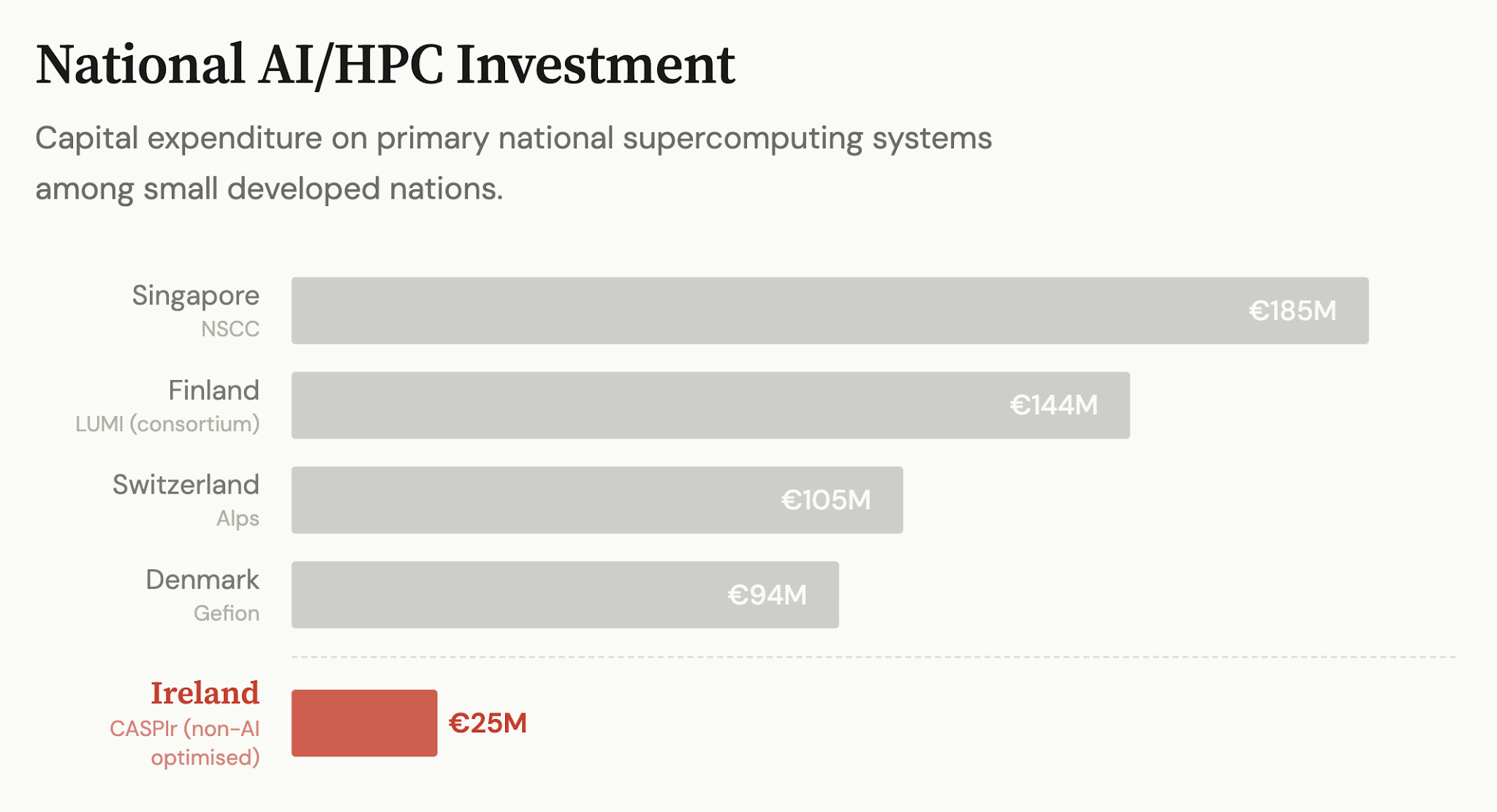
Ireland’s current lack of national infrastructure is what a new procurement from the Department of Further and Higher Education seeks to address. In March 2026, Minister James Lawless welcomed the launch of procurement for CASPIr, a EuroHPC supercomputer to be hosted by ICHEC and jointly owned by the University of Galway and the EuroHPC JU. According to the official EuroHPC JU press release, the total acquisition budget is €25 million, co-financed 35% by the EuroHPC JU from Digital Europe Programme funds and 65% by Ireland from national funds. The system is expected to be operational in 2027.
This is a meaningfully smaller commitment than the one Minister Lawless had publicly floated seven months earlier, when he told the Irish Times in August 2025 that a spend of “€60 million wouldn’t be unexpected” for the new national system. CASPIr is also planned to be a general-purpose HPC system. ICHEC’s own procurement page describes it as having “lower density of GPUs per node” and “lower memory configuration per GPU” compared to AI-optimised systems, and states that it “will not have sufficient capability for large-scale AI workloads.” ICHEC anticipates that “contention for access to GPUs is anticipated to develop within the first year of operation.”
The tender specification also reveals two design choices that point in the same direction. First, the specification that the GPU partition be vendor-agnostic between Nvidia’s CUDA architecture and AMD’s HIP architecture. The dominant frameworks for frontier AI research – PyTorch, JAX, the major training and inference libraries – are built around CUDA. AMD’s HIP is a viable choice for traditional scientific computing workloads, but a significant handicap for AI work in 2026. Any procurement that treats the two as interchangeable is one whose authors are not optimising for AI research. Second, the document caps GPU count at 4 per node – fine for general scientific computing, but a constraint when working with contemporary open-weight models, which are increasingly designed around 8-GPU node configurations.
In November 2025, Minister Lawles launched INSPIRE, a €750 million national research infrastructure programme running from 2026 to 2031. The two operative public documents describing the programme – the Programme Outline and the Research Infrastructure Working Group report – say nothing specific about HPC, and nothing at all about GPUs. The Outline mentions HPC only in a passing parenthetical, describing the €750 million package as “encompassing investment in Ireland’s High-Performance Computing HPC capability” with no euro figure attached. The Working Group report calls for strategic investment in HPC but does not specify what that investment looks like. No GPU count, performance class, or AI-specific allocation appears in any of INSPIRE’s published materials. CASPIr appears to be Ireland’s primary national HPC facility for the foreseeable future.
With a non-AI-optimised design, CASPIr’s effective AI compute capacity is likely 100-300 H100-equivalents, depending on what share of the €25 million budget is allocated to GPU nodes versus CPU, storage, and networking.
This is modest by international standards. Denmark, with a comparable population, deployed Gefion in October 2024 – an AI-optimised system with ~1,500 H100-equivalents. Switzerland’s Alps, operational since 2024, provides roughly 10,750 H100-equivalents to Swiss researchers.
The EuroHPC Joint Undertaking is also deploying 19 “AI Factories” across the continent – purpose-built AI computing facilities hosted in 16 European countries, with a combined investment of €1.5 billion. Ireland is not among them. It is one of 13 countries designated as “Antennas” – contributing €5 million to a networking programme that provides remote access to AI compute hosted in France and Luxembourg, but no domestic AI Factory.
Challenges
It is not obvious that infrastructure is where limited funding would have the most impact on Ireland’s frontier AI research presence. More competitive PhD stipends, targeted faculty recruitment, or restructured incentives to reduce the salary gap between academic research and multinational industry might do more per euro. Those systemic changes might also be harder to enact than scaling compute.
A more ambitious national HPC would face political headwinds. Ireland’s pre-tax electricity costs are already the most expensive in Europe. It has the highest proportion of electricity consumption from data centres in the EU – 22% of national metered electricity in 2024, with projections that it will reach 30–32% by 2030. The Commission for Regulation of Utilities’ December 2025 Large Energy Users Connection Policy now requires new data centres to provide dispatchable on-site generation as a condition of grid connection. This policy replaced the previous status quo, in which there was an effective moratorium on connecting new data centres to the grid.
A national research HPC facility would draw a small fraction of the power of a commercial data centre, but it would enter a policy environment shaped by public concern about grid strain.
Conclusion
Why does any of this matter beyond the research community?
Ireland’s AI sector is overwhelmingly a multinational one, a specific instance of a broader dependence. Foreign (mostly American) owned multinationals accounted for 84% of corporation tax revenues in 2023. Ireland’s current position in AI – a place where products built elsewhere are localised and sold into the European market – is economically valuable, but it depends on continued multinational presence.
Some people argue that compute will be one of the defining strategic resources of this century. They may be right; I am told a future Fitzwilliam essay will take up this topic again. The narrower question that has occupied my mind recently is why, despite so much talent and tech presence, Ireland is almost absent from frontier AI research.
A research ecosystem offers what engineering presence cannot. Innovation clusters are sticky: they produce knowledge spillovers, attract specialised talent, and are difficult to replicate or relocate once established. They are also a critical route by which national research talent reaches positions of influence inside the institutions that build the underlying technology: a small set of graduate AI research programmes produce the bulk of the senior research talent at frontier AI labs.
I left NeurIPS thinking about whether Ireland is producing the kind of research careers that give Irish scientists a strong chance of reaching those positions. On the current evidence, the answer is no.
Conor Igoe is an AI Research Scientist at Edison Scientific in San Francisco, a research lab developing AI to accelerate scientific discovery. He holds a PhD in machine learning from Carnegie Mellon University and a bachelor’s degree in electronic engineering from University College Dublin. There is an appendix to this post compiling Ireland’s research-accessible GPU resources available.
As far as I can tell. The link in question lists some awards for CPU, not GPU, allocations. Last checked May 6th 2026.

At Intercom we have a sizeable AI R&D presence in Dublin; you'll have to make your own mind up how far from the frontier we are, but we're doing some stuff.
We're sharing some work openly, e.g.
https://arxiv.org/abs/2601.11471
https://arxiv.org/abs/2603.12133
https://arxiv.org/abs/2602.12078
https://fin.ai/research/
We'd have hundreds of H100 equivalents dedicated to R&D.
We're also good at post-training, and doing some pretraining.
I'd say we're legitimately at the cutting edge in applied AI. Fin has >$100M ARR.
It would be amazing if there was the R&D presence here in Dublin that there is in London or Zurich (per capita).
Those are tough benchmarks though; path dependencies arising from Deepmind, Google Research
I'm not sure if having plentiful compute would make a big difference; but it wouldn't hurt.
It seems like one could equally ask, why are our maths departments so weak and underfunded when so much of AI, tech more generally and finance depends on having a mathematically-able workforce. We don't educate many to a *high* level (see PISA studies at secondary level); instead, we import outstanding people.
From an economic perspective, some might argue that it is unnecessary for *us* to fund advanced education and research, I don't know. It does hinder our young.